Taking advantage of Hardware Performance to Power Advanced Gameplay
Advanced gameplay is no longer defined by skill alone. In today’s gaming environment, performance is increasingly shaped by the computer hardware behind the screen. High refresh-rate monitors, powerful GPUs, low-latency CPUs, and fast SSD storage all contribute to smoother visuals, faster load times, and more responsive controls.
Within this performance-driven ecosystem, game boosters, such as experience multipliers, rank acceleration tools, and progression shortcuts, have taken on a more strategic role. Their effectiveness is no longer isolated; instead, it is amplified by the quality of the hardware supporting the gameplay experience.
The Evolution of Performance-Driven Gaming
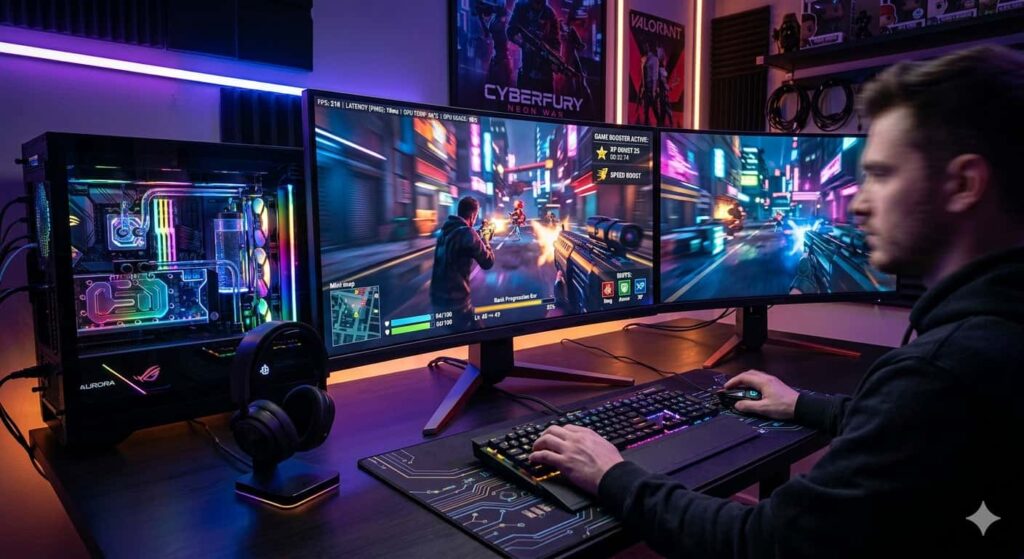
Modern games are built to leverage advanced hardware capabilities. Competitive titles and open-world environments demand high frame rates, minimal latency, and consistent system stability. Players who invest in optimized setups gain a noticeable advantage, not just in reaction time, but in overall gameplay clarity.
A high refresh-rate monitor, for instance, allows players to see smoother motion, making fast-paced interactions easier to track. A powerful GPU ensures that visuals remain stable even in complex scenes, while SSDs reduce load times, keeping gameplay uninterrupted.
This shift toward performance-driven gaming means that technical setup is no longer optional, it is a core part of the experience.
Understanding the Role of Game Boosters
Game boosters are designed to accelerate progress and enhance efficiency. These may include experience boosts that level up characters faster, rank-based boosters that help players climb competitive ladders, or optimization tools that improve system performance during gameplay.
For casual players, boosters reduce grind time, allowing them to unlock content more quickly. For competitive players, they can provide a pathway to higher ranks or access to advanced features without prolonged repetition.
However, boosters alone do not guarantee a better experience. Their true value depends on how effectively the system can support the gameplay environment in which they are used.
The Synergy between Hardware and Boosters
The interaction between hardware performance and booster usage is where optimization becomes most apparent. A player using a rank booster in a competitive game, for example, benefits significantly from low latency and stable frame rates. Without these, the advantage of faster progression may be undermined by inconsistent performance.
Similarly, experience boosters are more impactful when gameplay is smooth and uninterrupted. Faster load times and stable connections allow players to maximize active playtime, ensuring that boosted sessions are fully utilized.
High-performance systems also improve visual clarity and responsiveness, which can directly influence outcomes in skill-based scenarios. This means that boosters not only accelerate progression but also become more effective when paired with reliable hardware.
Competitive Advantage and Player Experience
For competitive players, the combination of strong hardware and boosters can create a measurable edge. Reduced lag improves reaction times, while higher frame rates provide clearer visual feedback. When paired with boosters that accelerate rank progression, players can climb faster while maintaining performance consistency.
Casual players, on the other hand, benefit from a more enjoyable experience. Smooth gameplay enhances immersion, while boosters help unlock new content without excessive time investment. The result is a balanced approach where both quality and progression speed are optimized.
This dual benefit highlights how modern gaming is no longer just about playing, it is about maximizing efficiency and experience simultaneously.
The Future of Optimized Gameplay
As gaming ecosystems continue to evolve, the relationship between hardware and in-game enhancements will become even more significant. Developers are increasingly designing games that reward both technical performance and strategic progression.
Cloud gaming, real-time updates, and cross-platform integration further emphasize the need for stable systems and efficient tools. In this environment, players who understand how to align their hardware setup with booster usage will be better positioned to achieve consistent results.
A Complete Approach to Gaming Optimization
The modern gaming landscape demands more than just skill or time investment. It requires a holistic approach where hardware performance and in-game tools work together.
Game boosters provide the means to accelerate progress, but their effectiveness depends on the system supporting them. High-quality hardware ensures that every boosted session is smooth, responsive, and fully optimized.
By combining strong technical setups with strategic booster usage, players can enhance both their gameplay quality and progression speed, creating a more efficient and rewarding gaming experience in today’s competitive environment.