
Menu

Haxasia

Great Machine Hardware

PC builders

Taking advantage of Hardware Performance to Power Advanced Gameplay

Advanced gameplay is no longer defined by skill alone. In today’s gaming environment, performance is increasingly shaped by the computer hardware behind the screen. High refresh-rate monitors, powerful GPUs, low-latency CPUs, and fast SSD storage all contribute to smoother visuals, faster load times, and more responsive controls.

Within this performance-driven ecosystem, game boosters, such as experience multipliers, rank acceleration tools, and progression shortcuts, have taken on a more strategic role. Their effectiveness is no longer isolated; instead, it is amplified by the quality of the hardware supporting the gameplay experience.

The Evolution of Performance-Driven Gaming
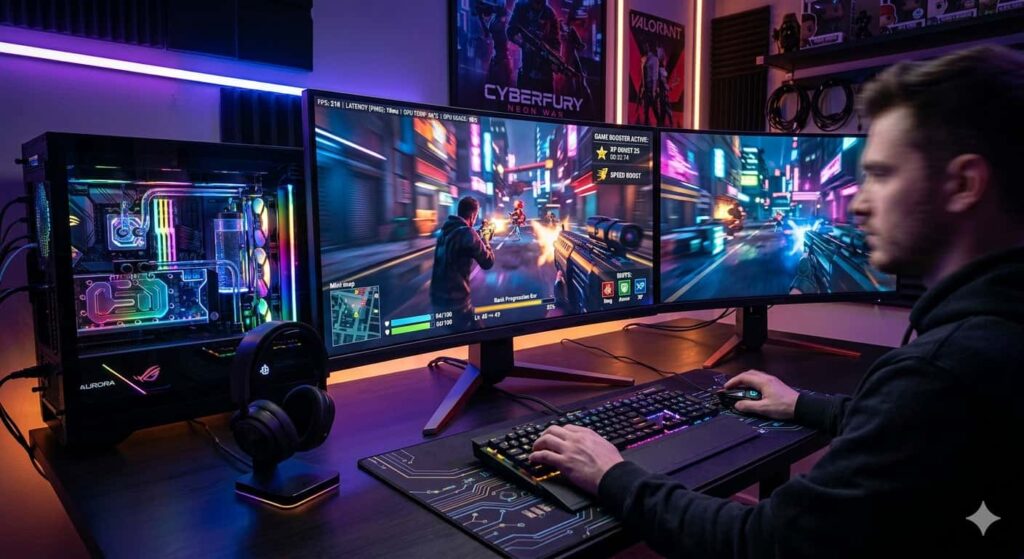
Modern games are built to leverage advanced hardware capabilities. Competitive titles and open-world environments demand high frame rates, minimal latency, and consistent system stability. Players who invest in optimized setups gain a noticeable advantage, not just in reaction time, but in overall gameplay clarity.

A high refresh-rate monitor, for instance, allows players to see smoother motion, making fast-paced interactions easier to track. A powerful GPU ensures that visuals remain stable even in complex scenes, while SSDs reduce load times, keeping gameplay uninterrupted.

This shift toward performance-driven gaming means that technical setup is no longer optional, it is a core part of the experience.

Understanding the Role of Game Boosters

Game boosters are designed to accelerate progress and enhance efficiency. These may include experience boosts that level up characters faster, rank-based boosters that help players climb competitive ladders, or optimization tools that improve system performance during gameplay.

For casual players, boosters reduce grind time, allowing them to unlock content more quickly. For competitive players, they can provide a pathway to higher ranks or access to advanced features without prolonged repetition.

However, boosters alone do not guarantee a better experience. Their true value depends on how effectively the system can support the gameplay environment in which they are used.

The Synergy between Hardware and Boosters

The interaction between hardware performance and booster usage is where optimization becomes most apparent. A player using a rank booster in a competitive game, for example, benefits significantly from low latency and stable frame rates. Without these, the advantage of faster progression may be undermined by inconsistent performance.

Similarly, experience boosters are more impactful when gameplay is smooth and uninterrupted. Faster load times and stable connections allow players to maximize active playtime, ensuring that boosted sessions are fully utilized.

High-performance systems also improve visual clarity and responsiveness, which can directly influence outcomes in skill-based scenarios. This means that boosters not only accelerate progression but also become more effective when paired with reliable hardware.

Competitive Advantage and Player Experience

For competitive players, the combination of strong hardware and boosters can create a measurable edge. Reduced lag improves reaction times, while higher frame rates provide clearer visual feedback. When paired with boosters that accelerate rank progression, players can climb faster while maintaining performance consistency.

Casual players, on the other hand, benefit from a more enjoyable experience. Smooth gameplay enhances immersion, while boosters help unlock new content without excessive time investment. The result is a balanced approach where both quality and progression speed are optimized.

This dual benefit highlights how modern gaming is no longer just about playing, it is about maximizing efficiency and experience simultaneously.

The Future of Optimized Gameplay

As gaming ecosystems continue to evolve, the relationship between hardware and in-game enhancements will become even more significant. Developers are increasingly designing games that reward both technical performance and strategic progression.

Cloud gaming, real-time updates, and cross-platform integration further emphasize the need for stable systems and efficient tools. In this environment, players who understand how to align their hardware setup with booster usage will be better positioned to achieve consistent results.

A Complete Approach to Gaming Optimization

The modern gaming landscape demands more than just skill or time investment. It requires a holistic approach where hardware performance and in-game tools work together.

Game boosters provide the means to accelerate progress, but their effectiveness depends on the system supporting them. High-quality hardware ensures that every boosted session is smooth, responsive, and fully optimized.

By combining strong technical setups with strategic booster usage, players can enhance both their gameplay quality and progression speed, creating a more efficient and rewarding gaming experience in today’s competitive environment.

Read More

Timing Matters: How Hardware Brands Schedule Reddit Posts for Maximum Visibility

According to a recent study by the Later website, posts on social platforms can see up to 50% more engagement simply because they were shared at the right time. Even the most impressive hardware benchmark can go unnoticed if it’s posted at the wrong time, lost in the sea of midnight memes and off‑hour announcements.

If you’ve ever lurked on r/buildapc or r/hardware, you know these communities move fast. A post that’s hot at 10 a.m. can be forgotten by lunchtime. That’s exactly why marketers in the PC gear world are obsessed with optimal Reddit posting times. They track when upvotes spike, when comments flood in, and when the next big launch hype hits. It’s a bit like surfing: catch the wave too early or too late and you wipe out.

The Race for Eyeballs in Fast‑Moving Threads

scheduling posts on laptop

Hardware communities on Reddit are one part nerd sanctuary, one part furious debate club. One minute people are arguing whether DDR5 is worth it, the next they’re comparing thermals between Radeon and GeForce. Posts that land during peak activity get upvoted into visibility. Ones that don’t? Crickets.

I remember a friend at a small PC parts company telling me how his boss once posted a benchmark at 2 a.m. local time. The results were mind‑blowing, and everyone agreed the data was solid. Yet no one saw the post until the next day when engagement had already cratered. “We had the gold,” he grumbled over coffee, “we just delivered it at breakfast with no audience.”

Marketers study patterns across subreddits, using tools from Reddit’s own analytics to third‑party dashboards from companies like Sprout Social and SocialBee. Reddit activity typically peaks in the late morning to early evening for U.S. time zones. That’s when most discussions, debate threads, and meme wars are at full tilt.

Why Timing Trumps Content (Sometimes)

Let’s be honest. A great article or benchmark usually wins the day. But on Reddit, timing shapes whether it even gets a chance. A GPU comparison posted at 3 p.m. EST may gather traction quickly, while the same content at 8 a.m. EST might drown in a backlog of overnight posts.

Linux enthusiasts and PC builders are particularly active in the afternoons and evenings. Schools let out, 9‑to‑5s hit break time, and suddenly the subreddit lights up. That’s when posts about custom water cooling systems or ultra‑wide monitors draw most comments and shares.

Hardware companies launching a new graphics card or modular PSU can’t afford to waste this. They now schedule posts like a DJ times a drop in an EDM set. Too soon and you’re forgotten. Too late and someone else owns the conversation.

Behind the Scenes of Scheduling

Hardware brands do more than glance at a clock. They collect data. They chart it. They analyze time zones. A launch meant for Asia Pacific may get scheduled for U.S. afternoon hours so both audiences see it at a reasonable time. Marketers even look at weekends versus weekdays. Some subreddits buzz more on Saturdays when builders have free time. Others behave like Wall Street, quiet on weekends and booming on Mondays.

There’s also the human element. Some moderators enforce posting windows to avoid spam or low‑quality content during peak hours. This means brands must be strategic, combining data insights with an understanding of community norms.

I once chatted with a community manager who joked that he feels like a weatherman. “I predict storms of comments at around 6 EST,” he said. “So I drop the post then.” His laugh revealed that there’s an art to this science. Data guides you, but understanding people makes the schedule work.

Engagement Costs and Benefits

Posting at peak hours isn’t a silver bullet, though. You might get more views, but you also face more competition. That means content must be sharp and backed by reliable systems. A dull build guide at 5 p.m. might get lost in the noise just like a genius benchmark at 3 a.m. Businesses that invest in hardware reliability and online reputation ensure their posts load fast, charts render correctly, and monitoring tools capture community feedback instantly, giving them a better chance of standing out even in high-traffic threads.

The payoff, however, can be huge. Time‑aligned posts receive better feedback, more community sharing, and often cross‑subreddit traction. A post that hits right can be picked up by r/tech and r/gadgets, extending reach beyond the initial hardware forum.

Ultimately, Reddit is a living, breathing ecosystem. It rewards relevance, timing, and authenticity. A well‑timed post about a new CPU benchmark can spark hours of conversation, lay the groundwork for brand trust, and send organic traffic pouring in.

Conclusion

Timing matters. It’s as simple as that. On Reddit, where threads move like wildfire and attention spans are short, knowing when to post can make a huge difference. Whether you’re launching a custom water block or sharing DIY PC tips, understanding peak activity windows is essential. As hardware marketers learn from data and human quirks, they turn timing into a tool for engagement, feedback, and community growth. Gear posts timed smartly have a better shot at being seen, shared, and talked about long after the initial upvote rush.

For anyone trying to build awareness in high‑traffic subreddits, mastering timing could be the thing that turns a good post into a great one with improved visibility and engagement.

Read More
𐌢